Integrated Individuals
Help us all become fully realized individuals and fully integrated members of society.
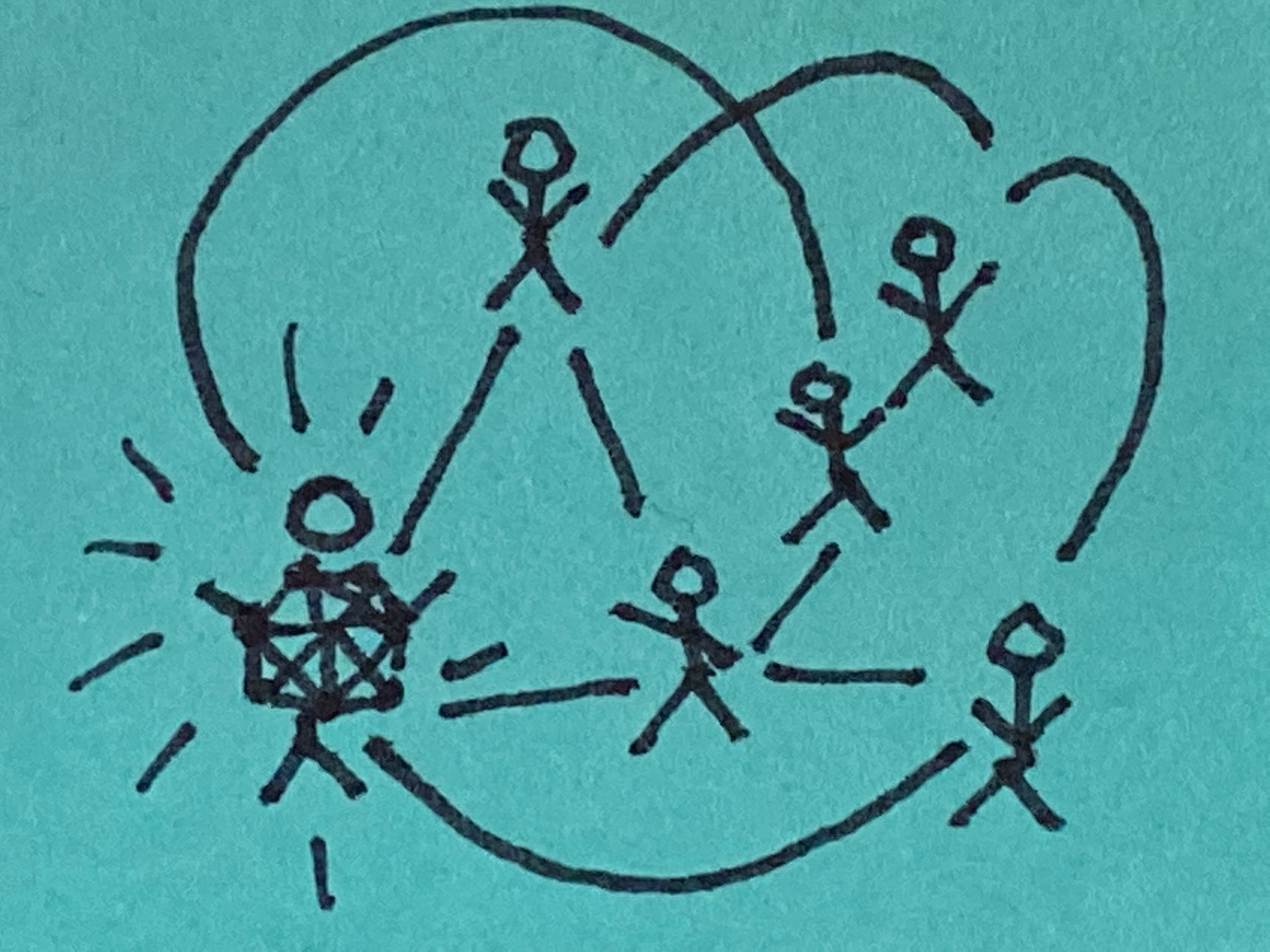
our Global Civilization encompasses all aspects of the human experience that we can influence, which makes it too broad to be an effective framework for taking action. We find that by dividing it into three narrower areas where we can effect change—within ourselves, our social structures and technologies, and our planet—we can make it more comprehensible. Consider now the kinds of people we all need to become in order to make a Global Civilization work. You might imagine that somehow we all need to be perfect beings of light, selflessly giving ourselves to the common good, but thankfully, it’s going to be a lot messier than that: lots of still-flawed individuals making choices that move us along the [[ Infinite Path ]].
Too many of us still see ourselves as independent beings, locked in a struggle to survive, willing to gain advantage for ourselves at the expense of other people, life and the planet.
The common thinking is that being independent is far better than being dependent on others. We work to ensure that when our children grow up, they’re able to take care of themselves. We expect them to get their own place, pay their own bills and not depend on the charity of others to get by. Certainly, there are some basic practical skills that we all need to master in order to function in society, but true independence—being completely self-reliant—is an illusion. Unless we’re living a very primitive life as a hermit, we depend on others to live.
I use dozens, maybe hundreds of tools every day from my coffee maker to my computer, car, and garage door opener. I’ve made none of these things myself. Other people made them, using materials mined and refined by many other people.
We depend on farmers to grow food, and on shipping companies to transport that food to stores where we can buy it. We can’t make all the things that we use in our homes, so we depend on manufacturers to do that for us. Of course, that dependence goes both ways: manufacturers depend on us to buy their products so they can pay for their groceries. In reality, we’re all dependent on each other; we are interdependent.
In the United States, we have the myth that we are a nation of rugged individuals: people who are independent and self-reliant. The truth is, however, that we all need each other, and we need the systems that produce and make available all the artifacts of a modern life, and we need Earth’s natural systems to survive.
If our civilization were another kind of complex adaptive system, a human body, then people would be equivalent to the cells of that body. In our bodies, specialized cells work together to maintain homeostasis and support the survival of the entire organism. I don’t want to get too deep into that kind of analogy, however, because people are not cells. Cells don’t have their own desires and wills like people do. So a fully functioning civilization is, in many ways, going to be more complex than even an organism as complex as the human body.
The part of the cell analogy I want to hold onto is this: an individual cell has multiple roles, some of which have to do with fulfilling it’s unique function and others of which have to do with cooperating with other cells to keep the whole organism alive.
In this pattern, I’m zoning in on two ideas that seem somewhat contradictory at first glance: individualism and cooperation. We often equate individualism with independence, and going even farther, with not needing other people. I think that’s incorrect. Being an individual means to be fully yourself, and as social beings, you can’t truly be yourself alone. As Fuller said, “unity is plural and, at minimum, is two.”
So we always have relationship, and it matters what that relationship is. If it’s combative, then we get conflict, if it’s cooperative, then we have the possibility of synergy.
We are an emergent property of universe.
All the events of the past and the ways that the galaxy and the solar system formed, and the Earth, and how life developed on our planet, and how oxygen increased in our atmosphere, and all the many interdependencies that exist within Earth’s ecosystems that provide clean air and water, all converged to create the necessary conditions for humans to emerge. In that sense, we are truly children of the universe.
We are part of an interdependent universe.
This is related to the first part in that it recognizes that we are all connected and dependent on each other and the rest of universe for our existence. Without other people, or air, or water, or gravity, or tides caused by the Moon, or energy from the Sun, we would not exist. If any of those things disappeared today, the rest of our time alive would be measured in days at best. Our survival is intimately connected to the survival of everything else.
We each have a unique role to play.
Each of us has a unique set of experiences and a unique creativity that we must offer to the universe. As a world creator, we have a unique capacity to direct our own evolution, and each of us has a unique contribution to the future we create together.
Our individual roles can combine synergistically to create things we can’t even imagine.
When unique people combine in meaningful ways, the new whole that’s created is often stronger than the sum of its parts. That is synergy, and it’s by cooperating and collaborating with each other, rather than competing with each other, that we will create what we need to thrive into the future.
Once these ideas are truly understood, things change. As the only known emergent property of universe that can understand how universe works, envision a better future, and affect our own evolution, it’s not a big leap to conclude that our purpose is to create that better future. Not just for a few of us, but for everyone: it doesn’t make sense to try to gain advantages at the expense of other people or the planet that we depend on.
Clearly, competition needs to be replaced with collaboration for us all to succeed. And to collaborate effectively, our own personal development, as well as the personal development of everyone else, is critically important if not compulsory. Otherwise, we’ll be unable to play our unique roles as we need to, and we’ll be unable to create real communities that can work together and find the synergies that will result in a true humanity emerging.
“And what we’re moving towards is a civilization where everyone actually identifies this way as an emergent property of the whole, as an interconnected part of universe, with a unique role to play, with unique synergies with all the other unique roles to play. And then with that synergy, with that human participation, then humanity actually becomes a thing, it actually becomes an emergent property. Right now, it’s an idea but we don’t have humanity, we don’t have civilization; we have humans bumping, right. We have a bunch of organelles that haven’t organized as a cell that starts breathing, right. You don’t have behavior of the whole that is centrally unconsciously self-organizing.” — Daniel Schmachtenberger, Emergence talk
(pulled in from another pattern)
-
If we focus too much on our individuality, trying to make ourselves stand out from the crowd, then we make choices that separate us from others and humanity as a coherent whole can never emerge (win/lose); but if we try to make ourselves too much like everyone else in an attempt to fit in, then we make choices that damage our dignity and the world loses the beauty and richness of our unique expression (lose/lose).
-
The more integrated you are, both internally and externally, the more likely you will be able to see the win/win choices that move us along the [[ Infinite Path ]].
-
I use the word “integrated” from a systems perspective. A system is made up of parts, but each of those parts is also a system. As individuals, we are complex systems, but we are also part of society. We need to be integrated, or whole both within ourselves and within our society.
-
To be integrated means, in one sense, to choose to be a more coherent part a larger whole. When an immigrant integrates into a new culture, they choose to adopt aspects of the new culture—speaking the local language, dressing like the locals—so they can operate with less friction (more coherency) in that culture. That might mean that they subordinate some of their original culture, under certain circumstances, with the goal of connecting better with others, but it doesn’t mean they give up who they are. They add the new culture to who they are as an individual, and choose how they express their individuality moment to moment.
-
In addition to the social or interpersonal meaning of integration, there is also an internal kind of integration that is part of being an individual. We’re exposed to all kinds of ideas and knowledge as we grow up and live our lives, and we tend to absorb it unconsciously. We learn by watching others which means we pick up bits and pieces of who we are from all over the place. We become more individualized when we work to really look at those bits and pieces and actively integrate them with our direct experience, our own understanding about the world, and the values we choose for ourselves. Later patterns talk about how to increase your capacities to see, understand and act in the world. It’s the integrated development of these capacities that make you an independent individual, but they also give you the capacity to connect with others in meaningful ways.
-
The idea that you have to choose between being part of something greater than yourself or being a true individual is false. You can be your true self, in all your wonky glory, and still connect with others and create coherent tribes. You may need to learn some new skills at connecting, but they’ll just add to who you are. And you may need to dial back some of your more antisocial tendencies when you’re connecting with others, but that’s only a temporary situation.
Therefore:
Increase your ability to make good choices that move humanity along the infinite path, by striving to be a fully integrated individual while also striving to be a fully integrated member of society. Embrace your individuality: you possess unique capacities, experience and knowledge that will allow you to contribute to the world in ways that no one else can. Simultaneously, embrace your part in the larger society and be willing to subordinate some parts of yourself for the benefit of everyone.
Your individuality and your connection to the greater whole are both enhanced by increasing your capacities—World Creators, Comprehensive Sensemakers, Artist-Poet-Scientists—and by participating in the process of making the world better—Creative Practice. Creating a web of strong relationships—Network of Friends—is a critical step to reaching other people. If you’re especially skilled at creating relationships like that, you may find that it is one of the things that is Yours To Do, though we should all be creating relationships, whether it’s easy or not