Global Civilization
Develop the new civilization that the Great Turning requires.
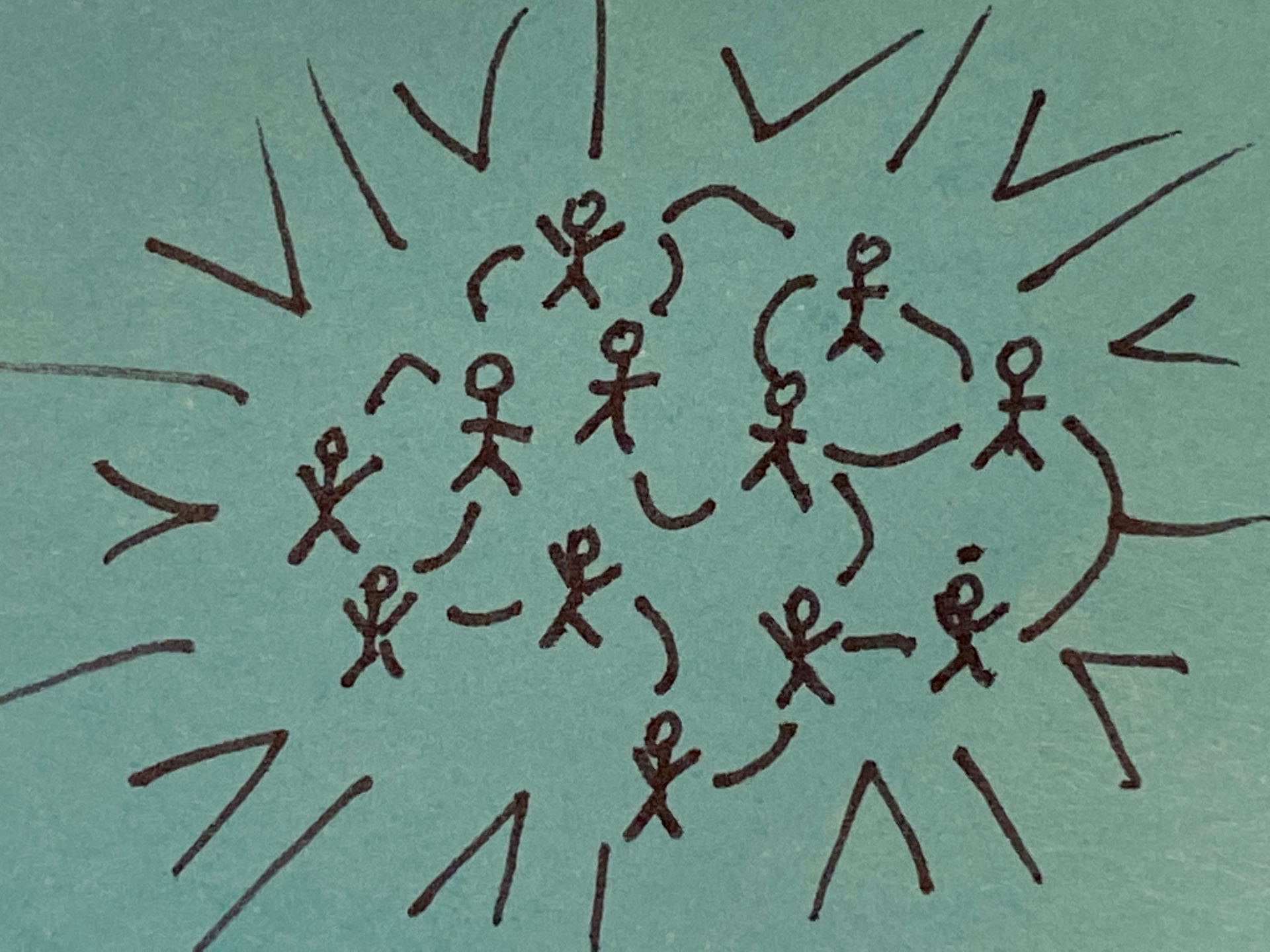
we know from Great Turning that the stories we get from the media are the stories of Business As Usual and to some degree the Great Unraveling. It follows that the people, institutions and organizations—what constitute our civilization—that we hear about are also part of those other stories. This pattern describes the kind of civilization that is developing in support of the Great Turning.
Global problems require global cooperation, but the major civilizations of today are based on competition, or worse, domination.
What exactly defines a civilization depends on what time period you’re referring to and who you talk to. But most would agree that modern civilizations include a complex society, with cities, people working specialized jobs, farms and industries supplying goods to the cities, and government.
But for the most part, a civilization is what happens when a large number of people need to
More generally, a modern civilization is a complex social system with lots of interconnected and interdependent parts, or centers. We can divide these centers into three broad categories to make them easier to comprehend:
- people,
- our human-designed world, and
- our planet Earth.
First, a civilization consists of people who have a shared idea of how things should work, a common vision in the broadest sense. In the Business As Usual civilization, we put our faith in the open market and capitalism that produces unlimited growth; we believe in representative democracy, but accept that outside influence is part of the process; we believe that people should have to earn a living as a way of fairly distributing limited resources, and much more.
Second, a civilization includes a set of human-designed systems that we use to manage lots and lots of people who don’t know or trust each other. That’s why we have things like banks and governments and stock markets, traffic laws and incredibly difficult tax forms. They set up the rules around how we interact and co-exist with each other. They also set up how we interact and co-exist with other nations.
Some of these systems make sense and enhance our ability to work cooperatively with each other. But many, many of them are based on competition and are biased toward the people in power. You could say they are asymmetric in how they distribute power, benefiting some at the expense of others, usually based on nationality, race, gender, wealth, sexual orientation, and so on.
And third, a civilization can be defined by its relationship to Nature. In some ways, civilization is our human response to a planet that could sometimes be dangerous. Wild animals, storms, drought and flood prompted us to build walls, shelters, aqueducts and much more to protect ourselves. In many civilizations Nature was something to be tamed and exploited, and that has led, in convoluted ways, to our current problems with climate change and loss of biodiversity.
So we find ourselves in a difficult time. The civilizations that we’ve built up over centuries are reaching a breaking point. We can no longer depend on familiar ways of doing things. But how do we change an entire civilization?
It’s been done before. About 20,000 years ago, we moved from living as roaming tribes of hunters and gatherers to raising crops on farms and living in cities. That transition took centuries to accomplish. Then about 300 years ago, we went from a primarily agricultural economy to an industrial economy. That transition was faster, taking less than a century. We’re now in another transition from an economy based on consumption and growth to one that is based on life-supporting systems for all life on the planet.
The good news is that the transition is already underway. There is a growing network of people and institutions that are working toward building a new kind of civilization, one that can make the Great Turning the dominant story of our time.
This cooperative world is largely hidden because it’s operating, not so much behind the scenes, but in the undeveloped spaces, or Latent Centers, within the existing civilizations. The new civilization is growing out of the old in a non-destructive way.
It’s worth noting that this global civilization is not a centralized world government or “new order,” and it’s more than a global community. It’s an emerging global system of decentralized governance: a collection of people, organizations and institutions located all around the world that work together, without central control, for the good of all people. To take advantage of global opportunities, it has a global scope. Its purpose is to ensure the survival and success of all humans. As a result, it has to reject systems that benefit some people at the expense of others or the planet. It cannot be globally selfish like the more regional civilizations that came before it. It gets its power by having citizens all over the world that can act locally in the civilization’s interest, building local projects and pushing for their national governments to act in the interests of all people.
This nascent global civilization has been around for a long time, but it’s been gathering steam in recent years. More politicians are pointing out the problems with the Business As Usual story, and there are a whole category of internet businesses that are determined to create real value for their customers. Led by people like Seth Godin and Marie Forleo, they’re looking for ways to recreate business as a positive force for the common good.
The people that make up this civilization were identified twenty years ago as the cultural creatives, a largely disconnected group of people who share values and an understanding of the world that is very much in line with the Great Turning. Twenty years ago, it was estimated that there were 50 million cultural creatives in the United States alone. Certainly, this number has been increasing and may be a significant percentage of the total population.
There are also many existing organizations that are trying to move us toward the Great Turning. NGOs and charities are part of it, but also some newer internet businesses, foundations, and activist groups. Developing alongside these people and organizations are technologies like the internet, blockchain and other tools that make organizations based on Symmetric Control more possible and practical. According to David Korten in his book The Great Turning: From Empire to Earth Community, there are an estimated million or more organizations working toward the Great Turning.
Therefore:
Work with others around the world to develop and strengthen the emerging global civilization: increase the number of people involved and create new world systems that support all people and help regenerate the Earth. Look for ways to create meaningful and cooperative relationships across all boundaries: national, ethnic, racial, economic, cultural, and so on.
Look for ways to help people become sufficiently enlightened—Collective Actualization—so they want to participate in creating the new civilization; build new world systems in and around the existing systems—Design Revolution—and work to undo as much damage as we can so the Earth can start to recover and continue to provide the life support that we depend on—Global Regeneration