SQVID
Walk your idea through the SQVID exercise as a way of activating your imagination.
when it comes to setting in order the facts of your experience, a picture is worth a thousand words.
When we look at the world from a single way of seeing, our imaginations get stuck and we end up uninspired.
-
This is a concept and framework that Dan Roam developed and explained in detail in his book The Back of the Napkin. It gives us a framework for exploring aspects of an idea or problem visually. Like many powerful frameworks, the idea is simple, but it can help generate an almost infinite number of ideas:
-
“At it’s most basic level, the SQVID is just a series of five questions that we walk our initial idea through in order to bring it to visual clarity and to refine its focus” (Roam, p. 106)
-
“The word SQVID is a simple mnemonic composed of the first letter of the first word of the […] five questions…. (Note: the V is taken from the Roman U, and the D from the Greek for delta, the symbol of change. So we could say this is both a multilingual and a classical SQUID.🙂)” (Roam, p. 106)
-
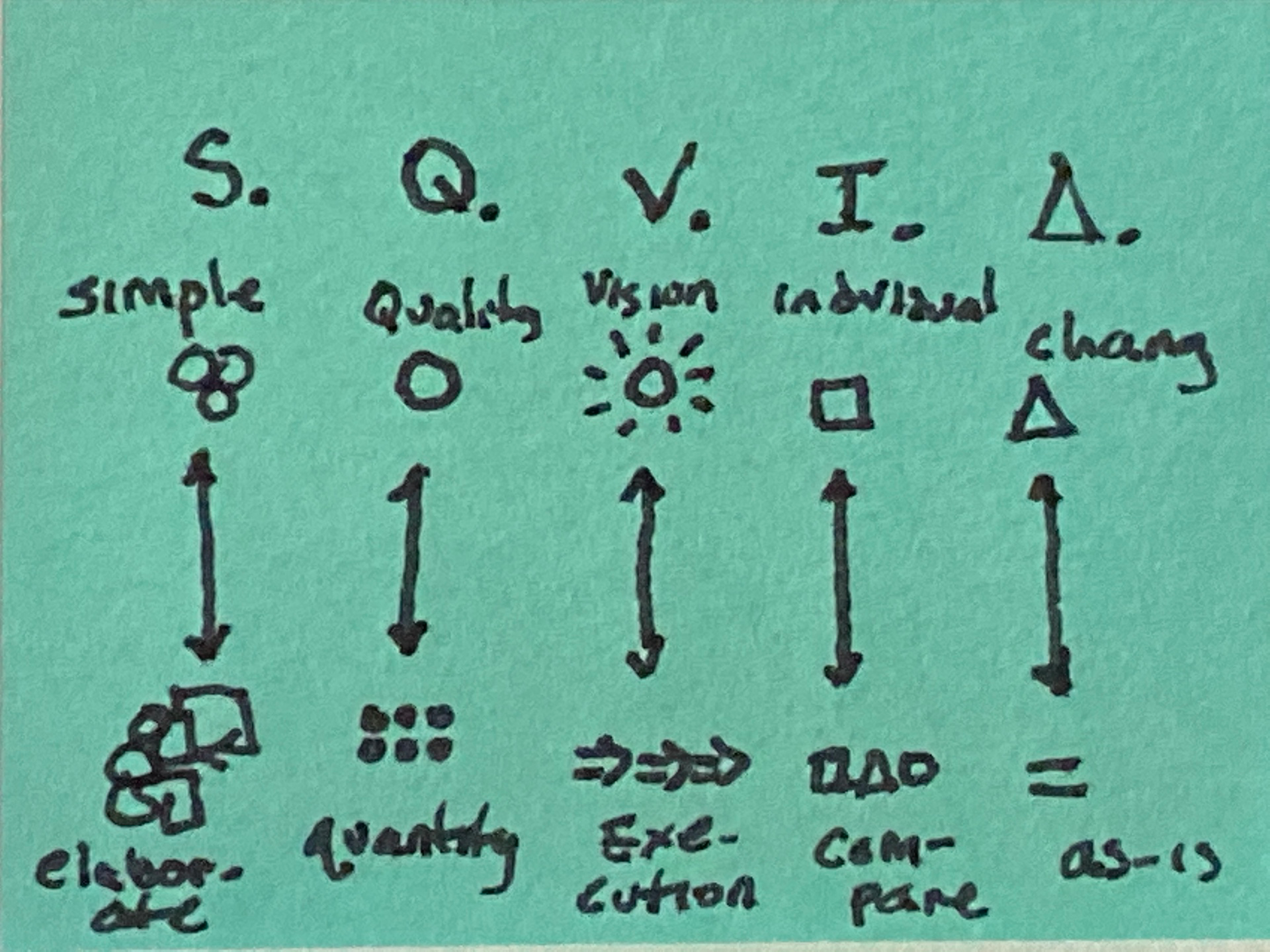
stands for: Simple vs. Elaborate
-
stands for: Quality vs. Quantity
-
stands for: Vision vs. Execution
-
stands for: Individual attributes vs. Comparison
-
stands for: Delta (or change) vs. Status quo (Roam, p. 107)
-
-
To use the SQVID, we “…walk through the five questions in order and think of how we could visually describe our idea according to each option: a simple view or an elaborate view, a qualitative view or a quantitative view, etc. Then, either on paper or just in our mind’s eye, draw out what each view might look like.” (Roam, p. 108)
-
“… this pathway through the SQVID forces our visual system to switch gears back and forth as we move from question to question, extreme to extreme. (Try it: I swear you can literally feel your mind’s eye grinding metal as it jumps from qualitative visual description to visionary visual description and so on. It’s a trip.) This shifting of gears in turn exercises corners of our mind’s eye we rarely explore, forcing us to conjure up images that we rarely think of. This pathway is ideal for generating an unexpectedly broad number of ways to visually represent our idea, and leaves us with many views to choose from when it comes time to pick which to show.” (Roam, p. 109)
-
“…By forcing ourselves to look at our idea from every point on the SQVID, a fascinating thing happens, with an equally fascinating outcome: we fully activate both the left (‘analytic’) and right (‘creative’) sides of our brain. This means that if we’re the kind of person who thrives on detailed quantitative analysis of problems, using the SQVID activates both our more familiar thinking style and the creative side that we don’t see so much. Conversely, if we consider ourselves as more visionary or qualitative, using the SQVID gets us to work out the kinks on our more analytic side.” (Roam, p. 110-111)
-
-
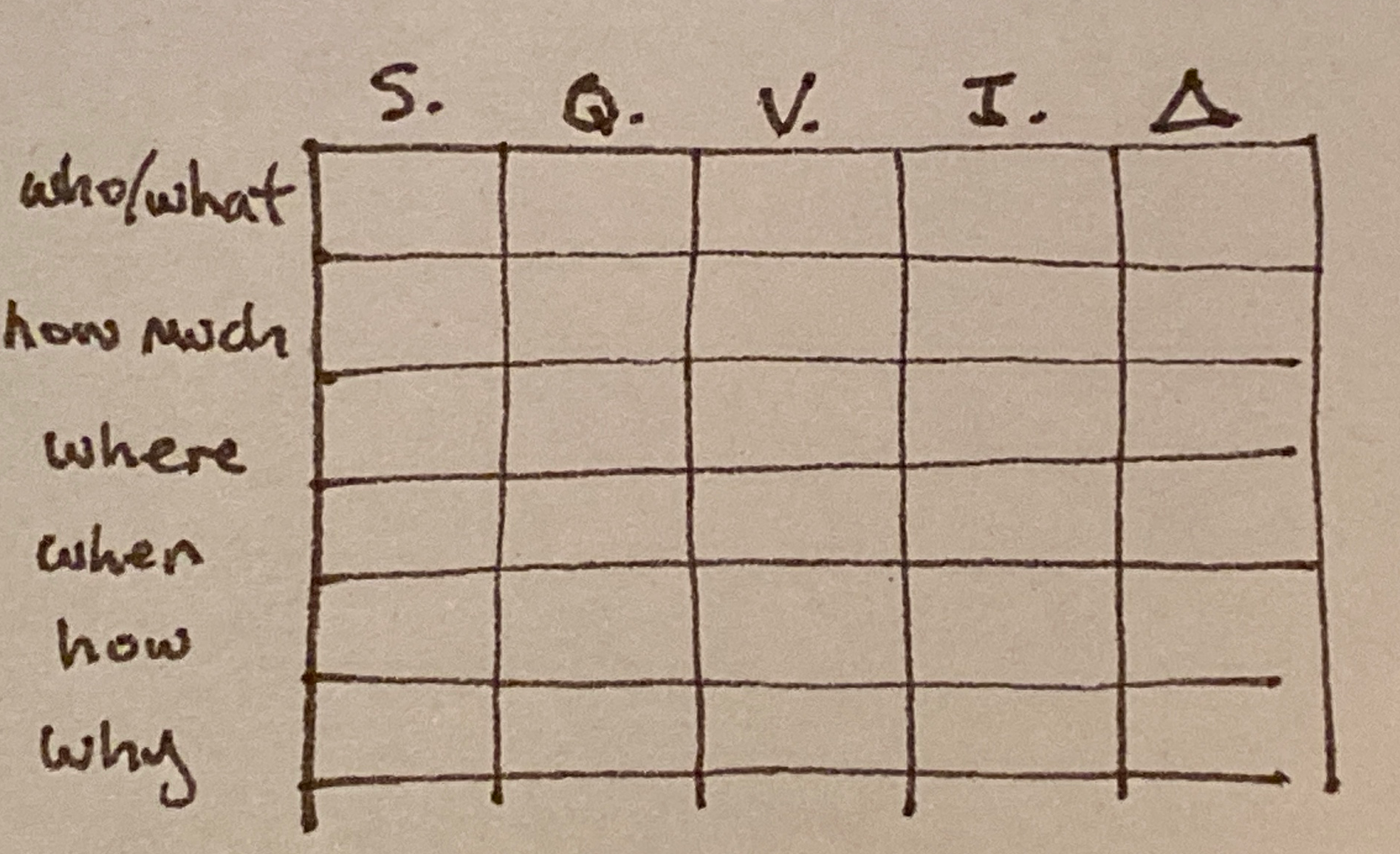
Dan Roam also relates certain visual frameworks to the familiar “six Ws:” who, what, when, where, why, and how. He changes them slightly to who/what, how much, when, where, how, and why. He calls these “the six ways of seeing” because they represent different ways that we can look at a problem or a phenomenon. The six visual frameworks are also patterns in this book:
-
If you combine the SQVID perspectives with the six visual frameworks, you get what Dan Roam calls the “Visual Thinking Codex.” It’s a great framework for representing just about anything visually.
Therefore:
Walk your idea through the SQVID exercise as a way of activating your whole brain, visual system and imagination.
Use the visual frameworks—Portrait, Chart, Timeline, Map, Flowchart, and Multi-Variable Plot—to communicate your thinking to yourself and others