Brainstorm
Generate new ideas, question assumptions, and make new connections by brainstorming.
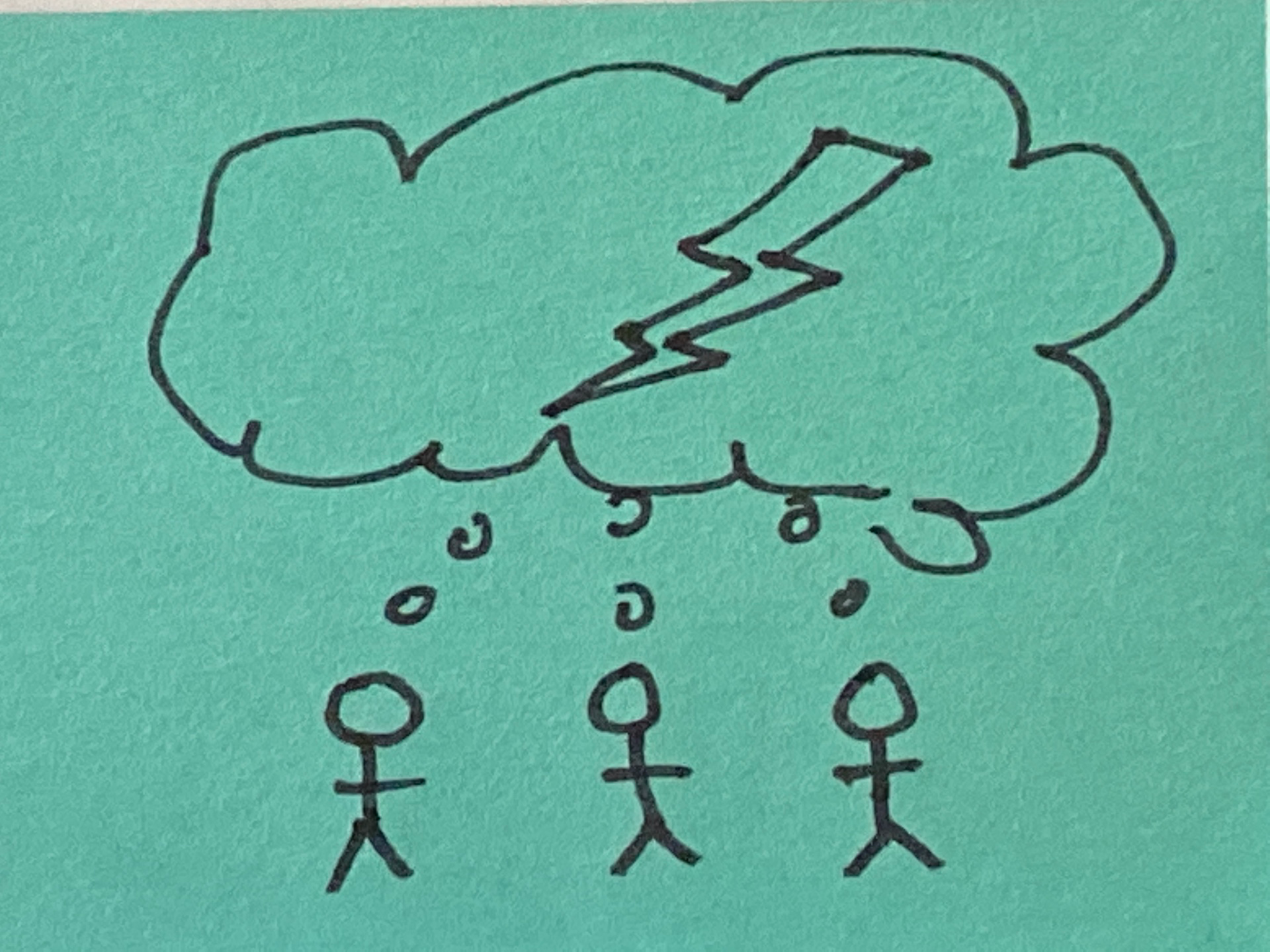
according to Rethinking, you can mine your experiences and make new connections within your Personal Universe on your own, but it can also be done collectively.
When it comes to generating ideas, a single person is limited by their individual habits of thinking and perspective.
-
Brainstorming is a technique where a group of people try to come up with new ideas together. It usually takes the form of a meeting where members of the group are given a topic or problem that needs to be solved. They then start a process of wring down ideas and sharing them with the group. As ideas are shared, they often spark new ideas which are then added until no more ideas can be thought of or time runs out.
-
In order to create a safe environment where people feel free to share, ideas can come freely, and creativity is maximized, there are rules that all members need to follow:
-
Go for quantity. Don’t worry about the quality of your idea; you never know what it might spark in someone else’s mind, so put it out there. The more the better.
-
Withhold criticism. This is similar to the rule about not editing while you write. Your critical mind is separate from you creative mind, and we want to activate your creative mind. In addition, if you’re critical of others’ ideas, they’re likely to shut down.
-
Welcome wild ideas. Get out of the box and think big. Be whimsical. Imagine technology that doesn’t exist yet. Don’t hold back because of practicality.
-
Combine and improve ideas. Take others’ ideas and run with them, add to them, turn them upside down, and make something new from them.
-
-
Brainstorming is a model for the infinite game: the rules are intended to keep play going as long as possible. It may not be truly infinite, but it’s at least non-rivalrous.
-
Brainstorming is usually used to generate new ideas, but you can use the same approach to generate other kinds of information and collective knowledge:
-
ConnectStorm: Look for ways that two ideas you are struggling with are related.
-
LearnStorm: Other perspectives can really help all of you to understand an idea better. A brainstorm can act like an interconnection of several minds, tapping into the experiences of others to create a more comprehensive understanding.
-
ScopeStorm: Look for relevant aspects of a problem that have not yet been considered. This can help expand your understanding of the scope of a system, for example.
-
Therefore:
Generate new ideas, question assumptions, and make new connections by brainstorming with others.
If you generate a large number of ideas, you may be able to better understand their relationships through Affinity Mapping